Showing posts with label Katoch-Dynasty. Show all posts

Monday

Sujanpur Tira: the Historic Town

           
Sujanpue Tira town, view from Sujanpur Tira Fort
                        The historic town of Sujanpur Tira is known for its fort-palace, now in ruins, built by Raja Sansar Chand. The Fort of Sujanpur Tira was originally built by Raja Abhay Chandra, in 1750, as a military Fort. In the reign of Raja Sansar Chandra (1765–1823) (the golden age of Kangra Kingdom) this fort gained renown through India, and was considered as one of the most beautiful palaces in the Himalayas. In 1905 this palace-fort was damaged by an earthquake. 
Main Gate for Sujanpur Tira Fort
Market of Sujanpur Tira


Raja Sanar Chand Katoch- "Pahadi Badshah" the emperor of the hills
                 In mid-18th century, as the Mugal Empire began to crumble, the 16-year-old Sansar Chand, decided to take advantage of the weak central rule. Raja Sansar Chand had successfully established himself as a powerful ruler and was able to set a deal with Jai Singh (King of Jaisinghpur in Kangra Valley) and re-captured the Kangra fort in 1774. He had to give some plain territories to Jai Singh in return.
     Sansar Chand quickly focused on the expanding his kingdom and conquered almost all neighboring regions, including Chamba, Mandi, Suket, Nahan, Bilaspur (present day regions in Himachal pradesh) all the way up to the border of Jammu.

All the defeated hill kings then sought help from Amar Singh Thapa, the Gurkha commander, and came together against Sansar Chand. They invaded Kangra with Gurkha troops and won the Kangra  fort.
   Faced with a terrible and embarrassing defeat, Sansar Chand went to Maharaja Ranjit Singh of Punjab for help, while also continuing to negotiate with Gorkhas. In return for help against the Gorkhas, Sansar Chand promised Maharaja Ranjit Singh the Kangra fort and the surrounding 76 villages, while he would keep the rest of the kingdom for himself. He promised the same deal to Gorkhas to get them off his back. Maharaja Ranjit Singh was quick to catch on to Sansar Chand's plan to keep the Sikhs and Gorkhas fighting each other, while he ruled Kangra.  (In 1809 for nearly a month a discussion went on at Jwalamukhi Temple between Maharaja Ranjit Singh of Punjab and Raja Sanar Chand of Kangra)

Finally, the Sikhs cut off the supplies of the Gorkhas and defeat them. Ranjit Singh then demanded that Sansar Chand keep a part of his bargain. Caught by surprise at the turn of events, Sansar Chand tried to wriggle out of his promise. However, Maharaja Ranjit Singh took A nirudh Chand, Sansar Chand's son prisoner and marched into Kangra fort.

Finally, Sansar Chand lost almost all that he had. All he got from the Sikhs was a small personal estate in lieu of which he had to pay an annual tribute of Rs 2,00,000 to the Ranjit Singh.  

The last days of Sansar Chand were spent in his estate in Sujanpur Tira in the Hamirpur district where he gave up his territorial ambitions and insted enjoyed the pleasures of a lavish court. Here he patronized poets and artists. The spectacular wall painting and temples of Sujanpur Tira  are reminders of his life in exile.
ruin of fort
ruin of fort
ruin of fort
ruin of fort
ruin of fort


                      Sujanpur Tira town is also famous for the temples of Gauri Shankar, Murli Mabohar and Narbadeshwar.  Narbadeshwar Temple is situated in Sujanpur town and was built by Rani(Queen) Prasanni Devi, the wife of Raja Sansar Chand. The temple is famed for its rich wall paintings that enhance the beauty of its walls. It is built in the Bhitti style of architecture.
Narbadeshwar Temple
Gauri Shankar temple 
Wall painting on Gauri Shankar Temple

  Sujanpur Tira is located on the bank of River Beas, at an average elevation of 562 metres (1,844 feet). In the middle of this beautiful town there is one square kilometer green ground popularly called in Pahari language 'Chaugan'. The largest ground of Himachal Pradesh which is made use of as a meeting place and also for sports activities. This town falls in district Hamirpur.
Sainik School Sujanpur Tira

                          In 1961, the idea of starting a chain of Sainik Schools as feeder institutions to NDA was envisaged by the then Defence Minister Mr V K Menon. The foundation of the school was laid by the then Prime Minister, Smt. Indira Gandhi in 1974 and finally Sainik School Sujanpur Tira (HP) was inaugurated by His Excellency Shri Neelam Sanjeeva Reddy, the then President of India on 02 Nov 1978.
Indias Public Service Broadcaster(Doordarshan relay centre) Sujanpur Tira


   Sujanpur Tira is about 25 kilometers from Hamirpur-town, 40 kilometers from Palampur-town and about 120 kilometers from Dharamshala.

Also seeJwalamukhiKangra fort|


Index........

Shaktipeeth Jwalamukhi Temple : Jwalamukhi Town

           
Jwalamukhi Temple also know as Jwala Ji Temple
            

   Jwalamukhi is a small town situated in Kangra District of Himachal Pradesh,about 35 kilometers from Kangra-town and about 55 kilometers from Dharamsala. The town is named after the Jwalamukhi Temple. 


Shaiyya bhavan (resting place) in the Temple campus..


Shaiyya bhavan (resting place) 

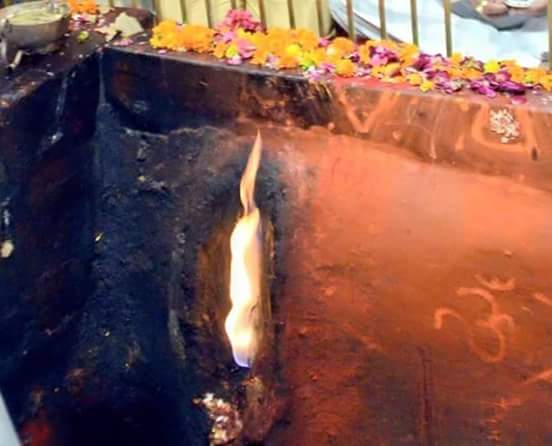
           Jwalamukhi Temple is famous Shaktipeeth where the tongue  of Pauranik Sati Parvati is stated to have fallen. The devi (goddess) is worshipped in form of a  flame.....(A legend says that after Goddess Sati sacrificed herself in the honor of Lord Shiva in her Fathers Yagya. Shiva took her body on his shoulder and started Tandav . In order to stop him from destroying the world Lord Vishnu divided the body of Sati into 51 parts with his Chakra. The tongue of Sati fell at this spot, thus making it a Shakti Peeth. )


 Hanuman Ji and Shani Dev idols in Jwalamukhi Temple

Jwalamukhi Temple was first constructed by Raja Bhumi Chand who had a dream about this sacred place where he decided to go and search for.After discovering this place,he decided to built a temple at this very place which came to be known as ‘Jwalamukhi’.


In Jwalamukhi Temple there is a 3 feet square pit with pathway all around and in the centre, there is a hollowed rock over a primary fissure of flame. This one is regarded as the mouth of the Mahakali.


The Flames emit out from several other point in the pit. They are nine in total which represent the different form of the goddess - Saraswati, Annapurna, Chandi, Hing Laj, Vindhya Vasini, Mahalakshmi, Mahakali, Ambika and Anjana. The Jwala Devi temple is dedicated to the Goddess of Light. The temple is made up of a dome and peak like pinnacles. The flame is believed to represent the Goddess.

Gold chhatri (umbrella) presented by Mughal emperor Akbar

According to legend, the great Mughal emperor Akbar visited Jawala Ji temple and tried to douse of the flame of the temple. However, when he was unsuccessful, he willingly submitted to the power of the goddess. He presented a gold chhatri (umbrella) for the goddess which is said to have turned into copper when he turned around to have a look at it before leaving.

gilt roof presented by Maharaja Ranjit Singh

Maharaja Ranjit Singh paid a visit to the temple in the year 1809. His son, Kharak Singh gifted a pair of silver plated folding doors to the temple while Ranjit Singh himself gave the gilt roof. Temple houses, a huge brass bell presented by the King of Nepal. 

Bell presented by King of Nepal


In 1809 for nearly a month a discussion went on at Jwalamukhi between Maharaja Ranjit Singh of Punjab and Raja Sanar Chand of Kangra. When Raja Sansar Chand's terms were accepted, Maharaja Ranjit Singh with his hand over the sacred flame, took an oath to do him no harm.


A sacred flame from this 3000 year old temple in Himachal Pradesh has been brought to Singapore to be placed newly-built sanctum of a local temple. The Jwala Ji shrine flame placed at Lakshminarayan Temple in Singapor's "Little India" shopping precinct, it was first time that flame travelled outside India. The flame was brought to Singapore on a 6 hours flight in a vessel similar to the lamp used to transport Olympic flame, it took 6 months to prepare the flame's journey. Singapore has thousand of Hindus from India, who always wanted to have Jwalaji flame there.
Street of Jwalamukhi town
Old market of Jwalamukhi town
Ruin of Jwalamukhi town

Tara Devi Temple at Jwalamukhi
See also: Shaktipeeth Vajreshwari Mata Temple |

Index......

Tuesday

Kangra Fort


Situated on the outskirts of Kangra town, in Himachal Pradesh, the Kangra Fort is witness to thousands of years of grandeur, invasion, war, wealth and evolution.
Ruin of kangra Fort 

Built in the times when history was not recorded, local legends credit Rajanaka Susherma Chandra (234th ruler from the founder Rajanaka Bhumi Chandra), who after being defeated in the battle of Mahabharat (allies of Kauravs) retreated to the valley and built this fort (presently accepted by the Archeological Survey of India as to be one of the oldest dated forts in India).

Kangra Fort is considered to be the largest fort in the Himalayas and according to the Archaeological Survey of India it is 8th largest in the country - covering an area of 463 acres.
View of Banganga river from Kangra fort.
View of Majhi river from Kangra fort


The Kangra Fort is distinguished for it strategic location, strength and impregnability. Situated at the confluence of the Banganga and Majhi rivers on top of a hillock made of boulder conglomerate the Kangra Fort overlooks the vast Kangra valley and the hill forms a natural fortifications. The fortifications walls are 4 kilometers. In circumference and rises approximately 300 feet above the river bed which surrounds the hill in three directions leaving only a small stretch of land connectivity towards the old Kangra town.
Ranjit Singh gate

The fort complex can be entered through a small courtyard juxtaposed between two gates known as 'Phatak' during the Sikh occupancy of the area.
Ahani Darwaza-(Iron Gate)
Amiri Darwaza-(Gate of Nobles)

A narrow path leads one to the interiors of the fortress through the 'Ahani Darwaza' (Iron Gate) and 'Amiri Darwaza' (Gate of Nobles)  both constructed during the aegis of Nawab Saif Ali Khan, the first Mughal governor of Kangra. 
Jahangiri Darwaza

As one ascends 500 feet along with the path one reaches the 'Jahangiri Darwaza' commissioned during the time of Jahangir, the illustrious Mughal ruler.


Andheri Darwaza (Dark Gate)

Then the path leads to the first defense gate called the Andheri Darwaza (dark gate) - this was built in order to stop/slow down the charge of an enemy army - above the side walls are flat grounds which accommodated the Katoch army who defended these gates from the vantage point.
Darshini Darwaza

Further up on the hills is the 'Darshini Darwaza' (the gate of worship) a colossal gateway guarded by river goddesses Ganga and Yamuna on either side of the main entrance to the central palace and the temple complex of the fort.
Ambika Devi Temple inside the fort...
Laxmi Marayan Temple inside the fort.
Idol of Mahavir
Ruin of Temple

The central religious complex comprises of stone carved temples of Ambika Devi, Laxmi Narayan and Jain Temple (a point of pilgrimage for the Jains as it holds the original idol of Mahavir).
Resident building inside the fort.

The flight of steps between these Temples leads to the Palace complex. The palace complex comprises of several buildings  such as Sheesh Mahal, resident buildings etc. 

Mythology of Kangra Royal family
Idol of Ambika devi inside the fort.

In the days of unrecorded history it is believed that the founder of the Katoch kingdom was Bhumi Chandra, who was born from the perspiration of the Goddess Ambika. The story narrated that when the Goddess Ambika while fighting the demon Rakathber, who could replicate himself with every drop of his blood (which fell on the ground), got tired of killing all his re-incarnations and wiped her forehead of the sweat, a drop of which fell on the earth and created Bhumi Chandra. Bhumi Chandra helped the Goddess in destroying the demon. So pleased was the Goddess with Bhumi Chandra that she bestowed upon him a large kingdom (Kutch-Khadi-Multan which stretched all the from the Tibetan borders in the Himalayas to the sea - Rann of Kutch, an area upwards of 1,25,000 sq. miles). The Goddess also conferred upon him the title of Rajanaka (Supreme King) and Katoch (Sanskrit for the best in swordsmanship).
Even to this day the title of Katoch is used by the Royal family as their surnames. The Goddess Ambika is worshiped as their clan Goddess (the temple of Ambika Mata is situated in the Kangra fort and is the oldest Ambika temple in India).
Idol of God Ganesha inside it fort

The Kangra Fort was through built to be unconquered was over powered by Mahmud of Ghazni in 1009. It was seized again in 1337 by Muhammad Bin Tughlaq and his successor Flroz Shah Tughlaq the Sultans of Delhi. The fort was never under the rule of the Muhammadan rulers until 1622, when after a failed attempt by Akbar, his son and successor Jahangir captured it and appointed a Governor to control the turbulence of the hill states against the Mughals. However with the exception of possession of the Rajput Katoch rulers of Kangra, who claimed to be the descendents of the Trigarta tribe. In the 2nd half of the 18th century, the Mughal rule declined, Raja Sansar Chand Katoch II succeeded in recapturing their ancestral fort and with him began the golden phase of Kangra art. His ambitions led him to come into conflict with several other hill states including the Gurkhas and Raja Ranjeet Singh of Punjab, who finally captured Kangra Fort in 1809, with him the Sikh rule was established. The Sikh hegemony was dismantled by the British troops who occupied the fort, till 1905 when the fort was destroyed by a severe earthquake which shook the entire Himachal Pradesh. After this grave disaster the fort was never inhabited.
Hammam (a commual bathhouse) in Kangra fort

Archaeological Museum 
   There is also a small archaeological Museum inside the Kangra fort. The museum was opened to the public on 26th January 2002.(update soon)                     
Rani ka Talaab
A small pound situated in the fort forest area, is said to be used by the queen, as the name suggest 'Rani Ka Talaab'- Pound of Queen. It is about 20 to 30 minutes trek from fort to reach the pound. 
Trek to Rani ka Talaab

The trek from Fort to Rani Ka Talaab is surrounded by dense shrubby forest of Banyan trees. There is very less number of people, who go there, as the forest is little scary. But the main reason is wild animals. 

See also: Nurpur Fort | Sujanpur Tira Fort |

Index.....

Dal : Chota Manimahesh, Shri Durveshvar Mahadev Temple, and Tibetan Children Village

Dal is a small village situated at a distance of  11 kilometers away from Dharamshala near the village of Tota Rani on McLeod Ganj - ...