Showing posts with label Hinduism. Show all posts

Monday

Dal : Chota Manimahesh, Shri Durveshvar Mahadev Temple, and Tibetan Children Village


Dal is a small village situated at a distance of  11 kilometers away from Dharamshala near the village of Tota Rani on McLeod Ganj - Naddi road in district Kangra, Himachal Pradesh. The village got its name from Dal Lake, a small mid-altitude lake, 1,775 meters above sea level.
foot path around Dal lake
Dal lake
Dal lake

     Dal lake is filled with greenish water and is surrounded by deodar trees. The lake is famous for its scenic beauty and pilgrimage center.   On the bank of Dal Lake, Shri Durveshvar Mahadev Temple is located (dedicated to Lord Shiva),  which is considered to be very sacred.
Shri Durveshvar Mahadev Temple, Dal
Nandi statue at Shri Durveshvar Mahadev Temple, Dal
      Shri Durveshvar Mahadev Temple was built by Mr Kalshar Singh Rana of village Gharoh in early 18th century. (Gharoh village is about 8 kilometers from Dharamshala and 19 kilometers from Dal). Dal lake is also known as "Chota (small) Mani Mahesh". Every year during the Hindu month of Badon on Radhastami, the 15th day following the festival of Janmashtami, (on August or September), the fair is held at Dal Lake. Thousands of pilgrims came to take holy dip in Dal lake,   seeking blessings of the Lord Shiva.  It is believed that the people who could not go to holy pilgrimage to the Mani Mahesh lake, they could come here.


       (   Mani Mahesh Lake  is a high altitude lake (elevation 4,080 metres (13,390 ft)) situated close to the Manimahesh Kailash Peak in the Pir Panjal Range of the Himalayas, in the Bharmour subdivision of Chamba district of the Himachal Pradesh. ) 
Mani Mahesh lake, Chamba (image is downloaded from internet)

Sheetla Mata Temple near Dal lake

                         Tibetan Children's Village (TCV) is just near Dal Lake,. Tibetan Children's Villages  is an integrated community in exile for the care and education of orphans, destitutes and refugee children from Tibet. It is a registered, nonprofit charitable organization with its main facility based at Dharamsala in Himachal Pradesh
Tibetan Children Village Gate Dal
TCV Ground......Dal


Index..............

Friday

Kotla Village (Kangra)

View of Kotla village from the Kotla fort

                                    Kotla is a Village situated on the National Highway 20 (Phathankot-Mandi road), in Himachal Pradesh. It is located in the Kangra district. The village is about 45 kilometres from Pathankot (Punjab) and the same distance from Dharamshala. The  Bhed khad (stream) and Dehar khad (stream)  cuts through the village, and both streams are tributaries of Beas river. The village is famous for it fresh water small local fish and there are many fish shops.
     
ruin of Kotla fort.....

The village is famous for the old fort - Kotla Fort,  Bagula Mukhi temple which is inside the fort, and a number of additional religious places. The Kotla Fort was built by the Raja Ram Chandra of Guler-Dynasty in early 16th century.
A footbridge that connect Kotla village with fort 
Bagula Mukhi temple

A yellow footbridge is constructed to connect the village with the fort. There is about 200 steps to reach the Fort. Inside the fort there is Bagula Mukhi temple.
steps to Kotla fort

Shiva temple in Kotla village

Index.......

Monday

Sujanpur Tira: the Historic Town

           
Sujanpue Tira town, view from Sujanpur Tira Fort
                        The historic town of Sujanpur Tira is known for its fort-palace, now in ruins, built by Raja Sansar Chand. The Fort of Sujanpur Tira was originally built by Raja Abhay Chandra, in 1750, as a military Fort. In the reign of Raja Sansar Chandra (1765–1823) (the golden age of Kangra Kingdom) this fort gained renown through India, and was considered as one of the most beautiful palaces in the Himalayas. In 1905 this palace-fort was damaged by an earthquake. 
Main Gate for Sujanpur Tira Fort
Market of Sujanpur Tira


Raja Sanar Chand Katoch- "Pahadi Badshah" the emperor of the hills
                 In mid-18th century, as the Mugal Empire began to crumble, the 16-year-old Sansar Chand, decided to take advantage of the weak central rule. Raja Sansar Chand had successfully established himself as a powerful ruler and was able to set a deal with Jai Singh (King of Jaisinghpur in Kangra Valley) and re-captured the Kangra fort in 1774. He had to give some plain territories to Jai Singh in return.
     Sansar Chand quickly focused on the expanding his kingdom and conquered almost all neighboring regions, including Chamba, Mandi, Suket, Nahan, Bilaspur (present day regions in Himachal pradesh) all the way up to the border of Jammu.

All the defeated hill kings then sought help from Amar Singh Thapa, the Gurkha commander, and came together against Sansar Chand. They invaded Kangra with Gurkha troops and won the Kangra  fort.
   Faced with a terrible and embarrassing defeat, Sansar Chand went to Maharaja Ranjit Singh of Punjab for help, while also continuing to negotiate with Gorkhas. In return for help against the Gorkhas, Sansar Chand promised Maharaja Ranjit Singh the Kangra fort and the surrounding 76 villages, while he would keep the rest of the kingdom for himself. He promised the same deal to Gorkhas to get them off his back. Maharaja Ranjit Singh was quick to catch on to Sansar Chand's plan to keep the Sikhs and Gorkhas fighting each other, while he ruled Kangra.  (In 1809 for nearly a month a discussion went on at Jwalamukhi Temple between Maharaja Ranjit Singh of Punjab and Raja Sanar Chand of Kangra)

Finally, the Sikhs cut off the supplies of the Gorkhas and defeat them. Ranjit Singh then demanded that Sansar Chand keep a part of his bargain. Caught by surprise at the turn of events, Sansar Chand tried to wriggle out of his promise. However, Maharaja Ranjit Singh took A nirudh Chand, Sansar Chand's son prisoner and marched into Kangra fort.

Finally, Sansar Chand lost almost all that he had. All he got from the Sikhs was a small personal estate in lieu of which he had to pay an annual tribute of Rs 2,00,000 to the Ranjit Singh.  

The last days of Sansar Chand were spent in his estate in Sujanpur Tira in the Hamirpur district where he gave up his territorial ambitions and insted enjoyed the pleasures of a lavish court. Here he patronized poets and artists. The spectacular wall painting and temples of Sujanpur Tira  are reminders of his life in exile.
ruin of fort
ruin of fort
ruin of fort
ruin of fort
ruin of fort


                      Sujanpur Tira town is also famous for the temples of Gauri Shankar, Murli Mabohar and Narbadeshwar.  Narbadeshwar Temple is situated in Sujanpur town and was built by Rani(Queen) Prasanni Devi, the wife of Raja Sansar Chand. The temple is famed for its rich wall paintings that enhance the beauty of its walls. It is built in the Bhitti style of architecture.
Narbadeshwar Temple
Gauri Shankar temple 
Wall painting on Gauri Shankar Temple

  Sujanpur Tira is located on the bank of River Beas, at an average elevation of 562 metres (1,844 feet). In the middle of this beautiful town there is one square kilometer green ground popularly called in Pahari language 'Chaugan'. The largest ground of Himachal Pradesh which is made use of as a meeting place and also for sports activities. This town falls in district Hamirpur.
Sainik School Sujanpur Tira

                          In 1961, the idea of starting a chain of Sainik Schools as feeder institutions to NDA was envisaged by the then Defence Minister Mr V K Menon. The foundation of the school was laid by the then Prime Minister, Smt. Indira Gandhi in 1974 and finally Sainik School Sujanpur Tira (HP) was inaugurated by His Excellency Shri Neelam Sanjeeva Reddy, the then President of India on 02 Nov 1978.
Indias Public Service Broadcaster(Doordarshan relay centre) Sujanpur Tira


   Sujanpur Tira is about 25 kilometers from Hamirpur-town, 40 kilometers from Palampur-town and about 120 kilometers from Dharamshala.

Also see:  Jwalamukhi | Kangra fort|


Index........

Shaktipeeth Jwalamukhi Temple : Jwalamukhi Town

           
Jwalamukhi Temple also know as Jwala Ji Temple
            

   Jwalamukhi is a small town situated in Kangra District of Himachal Pradesh,about 35 kilometers from Kangra-town and about 55 kilometers from Dharamsala. The town is named after the Jwalamukhi Temple. 


Shaiyya bhavan (resting place) in the Temple campus..


Shaiyya bhavan (resting place) 

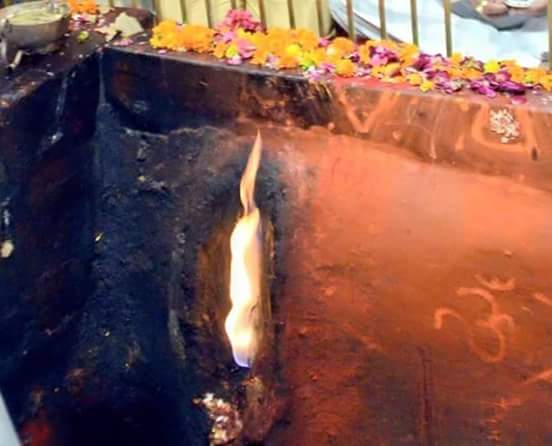
           Jwalamukhi Temple is famous Shaktipeeth where the tongue  of Pauranik Sati Parvati is stated to have fallen. The devi (goddess) is worshipped in form of a  flame.....(A legend says that after Goddess Sati sacrificed herself in the honor of Lord Shiva in her Fathers Yagya. Shiva took her body on his shoulder and started Tandav . In order to stop him from destroying the world Lord Vishnu divided the body of Sati into 51 parts with his Chakra. The tongue of Sati fell at this spot, thus making it a Shakti Peeth. )


 Hanuman Ji and Shani Dev idols in Jwalamukhi Temple

Jwalamukhi Temple was first constructed by Raja Bhumi Chand who had a dream about this sacred place where he decided to go and search for.After discovering this place,he decided to built a temple at this very place which came to be known as ‘Jwalamukhi’.


In Jwalamukhi Temple there is a 3 feet square pit with pathway all around and in the centre, there is a hollowed rock over a primary fissure of flame. This one is regarded as the mouth of the Mahakali.


The Flames emit out from several other point in the pit. They are nine in total which represent the different form of the goddess - Saraswati, Annapurna, Chandi, Hing Laj, Vindhya Vasini, Mahalakshmi, Mahakali, Ambika and Anjana. The Jwala Devi temple is dedicated to the Goddess of Light. The temple is made up of a dome and peak like pinnacles. The flame is believed to represent the Goddess.

Gold chhatri (umbrella) presented by Mughal emperor Akbar

According to legend, the great Mughal emperor Akbar visited Jawala Ji temple and tried to douse of the flame of the temple. However, when he was unsuccessful, he willingly submitted to the power of the goddess. He presented a gold chhatri (umbrella) for the goddess which is said to have turned into copper when he turned around to have a look at it before leaving.

gilt roof presented by Maharaja Ranjit Singh

Maharaja Ranjit Singh paid a visit to the temple in the year 1809. His son, Kharak Singh gifted a pair of silver plated folding doors to the temple while Ranjit Singh himself gave the gilt roof. Temple houses, a huge brass bell presented by the King of Nepal. 

Bell presented by King of Nepal


In 1809 for nearly a month a discussion went on at Jwalamukhi between Maharaja Ranjit Singh of Punjab and Raja Sanar Chand of Kangra. When Raja Sansar Chand's terms were accepted, Maharaja Ranjit Singh with his hand over the sacred flame, took an oath to do him no harm.


A sacred flame from this 3000 year old temple in Himachal Pradesh has been brought to Singapore to be placed newly-built sanctum of a local temple. The Jwala Ji shrine flame placed at Lakshminarayan Temple in Singapor's "Little India" shopping precinct, it was first time that flame travelled outside India. The flame was brought to Singapore on a 6 hours flight in a vessel similar to the lamp used to transport Olympic flame, it took 6 months to prepare the flame's journey. Singapore has thousand of Hindus from India, who always wanted to have Jwalaji flame there.
Street of Jwalamukhi town
Old market of Jwalamukhi town
Ruin of Jwalamukhi town

Tara Devi Temple at Jwalamukhi
See also: Shaktipeeth Vajreshwari Mata Temple |

Index......

Dal : Chota Manimahesh, Shri Durveshvar Mahadev Temple, and Tibetan Children Village

Dal is a small village situated at a distance of  11 kilometers away from Dharamshala near the village of Tota Rani on McLeod Ganj - ...