Showing posts with label Town. Show all posts

Thursday

Divine Dharamshala : Winter Capital of Himachal Pradesh

Dharamshala

Dharamshala  is a beautiful hill station nestled on the foot hill of majestic Dhauladar ranges. Dharamshala has been selected as one of the hundred Indian cities to be developed as a smart city. On 19 January 2017, Dharamshala was declared winter capital of Himachal Pradesh. It also serves as the district headquarters of Kangra district. 
Dharamshala

                             
                                        Since 1960 when it become a temporary headquarter of His Holiness, the 14th Dalai Lama, Dharamshala has risen to international fame as 'The little Lhasa in India'. From 2012 Dharamshala hosts yearly International Film Festival, showcasing the best of recent Indian and world cinema, including fiction, documentaries and shorts. Dharamsala is also best known internationally for International Cricket Stadium (Himachal Pradesh Cricket Association Stadium). Dharamshala is known as Yoga and Mediation center as there are many institutes of Yoga and mediation in Upper Dharamshala, specially Dharamkot, McLeod Ganj and Naddi.


Dharamshala

      The altitude of Dharamshala is between 1,065 m (3,494 ft) to 2,352  m (7,717 ft), which is interesting fact about this town. Dharamsala receives the highest rainfall, nearly about 3400 mm, in the Himachal Pradesh state. Dharamshala is surrounded by dense coniferous forest consisting mainly of Deodar,  Pine, Oak, and Rhododendron trees. 
Clock Tower at Sidhbari (or Sidhwari)....Dharamshala....

The suburbs include McLeod Ganj, Bhagsunag, Dharamkot, Naddi , ForsythGanj, Gamru, Tahu, Chohla,  Kotwali Bazaar (the main market), Depot Bazaar, Jawahar Nagar,Sakoh, Sheela, khanyara, Chilgari, Kaccheri Adda, Barol, Darnoo, Dari, Ramnagar, Shyamnagar, Sidhpur, Rakkar, Fatehpur, and Sidhwari.
Maximus Mall and Gold Multiplex Cinema, Dharamshala
Dharamshala Bus Stand
View of sun set from Cant road near Kotwali Bazaar

Related posts...........
 / Bhagsunag / Brig Sher Jung Thapa MVC Park / Church of St. John / Dharamkot / Gallu / Gyuto Tantric Monastery / Leta Wali Mata Temple / McLeod Ganj / Naddi / Norbulingka Institute / Triund Campsite / Tushita Meditation Centre / War Memorial park /


Index.............

Monday

Sujanpur Tira: the Historic Town

           
Sujanpue Tira town, view from Sujanpur Tira Fort
                        The historic town of Sujanpur Tira is known for its fort-palace, now in ruins, built by Raja Sansar Chand. The Fort of Sujanpur Tira was originally built by Raja Abhay Chandra, in 1750, as a military Fort. In the reign of Raja Sansar Chandra (1765–1823) (the golden age of Kangra Kingdom) this fort gained renown through India, and was considered as one of the most beautiful palaces in the Himalayas. In 1905 this palace-fort was damaged by an earthquake. 
Main Gate for Sujanpur Tira Fort
Market of Sujanpur Tira


Raja Sanar Chand Katoch- "Pahadi Badshah" the emperor of the hills
                 In mid-18th century, as the Mugal Empire began to crumble, the 16-year-old Sansar Chand, decided to take advantage of the weak central rule. Raja Sansar Chand had successfully established himself as a powerful ruler and was able to set a deal with Jai Singh (King of Jaisinghpur in Kangra Valley) and re-captured the Kangra fort in 1774. He had to give some plain territories to Jai Singh in return.
     Sansar Chand quickly focused on the expanding his kingdom and conquered almost all neighboring regions, including Chamba, Mandi, Suket, Nahan, Bilaspur (present day regions in Himachal pradesh) all the way up to the border of Jammu.

All the defeated hill kings then sought help from Amar Singh Thapa, the Gurkha commander, and came together against Sansar Chand. They invaded Kangra with Gurkha troops and won the Kangra  fort.
   Faced with a terrible and embarrassing defeat, Sansar Chand went to Maharaja Ranjit Singh of Punjab for help, while also continuing to negotiate with Gorkhas. In return for help against the Gorkhas, Sansar Chand promised Maharaja Ranjit Singh the Kangra fort and the surrounding 76 villages, while he would keep the rest of the kingdom for himself. He promised the same deal to Gorkhas to get them off his back. Maharaja Ranjit Singh was quick to catch on to Sansar Chand's plan to keep the Sikhs and Gorkhas fighting each other, while he ruled Kangra.  (In 1809 for nearly a month a discussion went on at Jwalamukhi Temple between Maharaja Ranjit Singh of Punjab and Raja Sanar Chand of Kangra)

Finally, the Sikhs cut off the supplies of the Gorkhas and defeat them. Ranjit Singh then demanded that Sansar Chand keep a part of his bargain. Caught by surprise at the turn of events, Sansar Chand tried to wriggle out of his promise. However, Maharaja Ranjit Singh took A nirudh Chand, Sansar Chand's son prisoner and marched into Kangra fort.

Finally, Sansar Chand lost almost all that he had. All he got from the Sikhs was a small personal estate in lieu of which he had to pay an annual tribute of Rs 2,00,000 to the Ranjit Singh.  

The last days of Sansar Chand were spent in his estate in Sujanpur Tira in the Hamirpur district where he gave up his territorial ambitions and insted enjoyed the pleasures of a lavish court. Here he patronized poets and artists. The spectacular wall painting and temples of Sujanpur Tira  are reminders of his life in exile.
ruin of fort
ruin of fort
ruin of fort
ruin of fort
ruin of fort


                      Sujanpur Tira town is also famous for the temples of Gauri Shankar, Murli Mabohar and Narbadeshwar.  Narbadeshwar Temple is situated in Sujanpur town and was built by Rani(Queen) Prasanni Devi, the wife of Raja Sansar Chand. The temple is famed for its rich wall paintings that enhance the beauty of its walls. It is built in the Bhitti style of architecture.
Narbadeshwar Temple
Gauri Shankar temple 
Wall painting on Gauri Shankar Temple

  Sujanpur Tira is located on the bank of River Beas, at an average elevation of 562 metres (1,844 feet). In the middle of this beautiful town there is one square kilometer green ground popularly called in Pahari language 'Chaugan'. The largest ground of Himachal Pradesh which is made use of as a meeting place and also for sports activities. This town falls in district Hamirpur.
Sainik School Sujanpur Tira

                          In 1961, the idea of starting a chain of Sainik Schools as feeder institutions to NDA was envisaged by the then Defence Minister Mr V K Menon. The foundation of the school was laid by the then Prime Minister, Smt. Indira Gandhi in 1974 and finally Sainik School Sujanpur Tira (HP) was inaugurated by His Excellency Shri Neelam Sanjeeva Reddy, the then President of India on 02 Nov 1978.
Indias Public Service Broadcaster(Doordarshan relay centre) Sujanpur Tira


   Sujanpur Tira is about 25 kilometers from Hamirpur-town, 40 kilometers from Palampur-town and about 120 kilometers from Dharamshala.

Also see:  Jwalamukhi | Kangra fort|


Index........

Shaktipeeth Jwalamukhi Temple : Jwalamukhi Town

           
Jwalamukhi Temple also know as Jwala Ji Temple
            

   Jwalamukhi is a small town situated in Kangra District of Himachal Pradesh,about 35 kilometers from Kangra-town and about 55 kilometers from Dharamsala. The town is named after the Jwalamukhi Temple. 


Shaiyya bhavan (resting place) in the Temple campus..


Shaiyya bhavan (resting place) 

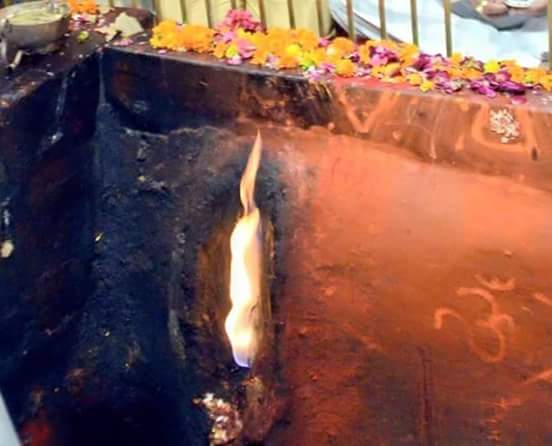
           Jwalamukhi Temple is famous Shaktipeeth where the tongue  of Pauranik Sati Parvati is stated to have fallen. The devi (goddess) is worshipped in form of a  flame.....(A legend says that after Goddess Sati sacrificed herself in the honor of Lord Shiva in her Fathers Yagya. Shiva took her body on his shoulder and started Tandav . In order to stop him from destroying the world Lord Vishnu divided the body of Sati into 51 parts with his Chakra. The tongue of Sati fell at this spot, thus making it a Shakti Peeth. )


 Hanuman Ji and Shani Dev idols in Jwalamukhi Temple

Jwalamukhi Temple was first constructed by Raja Bhumi Chand who had a dream about this sacred place where he decided to go and search for.After discovering this place,he decided to built a temple at this very place which came to be known as ‘Jwalamukhi’.


In Jwalamukhi Temple there is a 3 feet square pit with pathway all around and in the centre, there is a hollowed rock over a primary fissure of flame. This one is regarded as the mouth of the Mahakali.


The Flames emit out from several other point in the pit. They are nine in total which represent the different form of the goddess - Saraswati, Annapurna, Chandi, Hing Laj, Vindhya Vasini, Mahalakshmi, Mahakali, Ambika and Anjana. The Jwala Devi temple is dedicated to the Goddess of Light. The temple is made up of a dome and peak like pinnacles. The flame is believed to represent the Goddess.

Gold chhatri (umbrella) presented by Mughal emperor Akbar

According to legend, the great Mughal emperor Akbar visited Jawala Ji temple and tried to douse of the flame of the temple. However, when he was unsuccessful, he willingly submitted to the power of the goddess. He presented a gold chhatri (umbrella) for the goddess which is said to have turned into copper when he turned around to have a look at it before leaving.

gilt roof presented by Maharaja Ranjit Singh

Maharaja Ranjit Singh paid a visit to the temple in the year 1809. His son, Kharak Singh gifted a pair of silver plated folding doors to the temple while Ranjit Singh himself gave the gilt roof. Temple houses, a huge brass bell presented by the King of Nepal. 

Bell presented by King of Nepal


In 1809 for nearly a month a discussion went on at Jwalamukhi between Maharaja Ranjit Singh of Punjab and Raja Sanar Chand of Kangra. When Raja Sansar Chand's terms were accepted, Maharaja Ranjit Singh with his hand over the sacred flame, took an oath to do him no harm.


A sacred flame from this 3000 year old temple in Himachal Pradesh has been brought to Singapore to be placed newly-built sanctum of a local temple. The Jwala Ji shrine flame placed at Lakshminarayan Temple in Singapor's "Little India" shopping precinct, it was first time that flame travelled outside India. The flame was brought to Singapore on a 6 hours flight in a vessel similar to the lamp used to transport Olympic flame, it took 6 months to prepare the flame's journey. Singapore has thousand of Hindus from India, who always wanted to have Jwalaji flame there.
Street of Jwalamukhi town
Old market of Jwalamukhi town
Ruin of Jwalamukhi town

Tara Devi Temple at Jwalamukhi
See also: Shaktipeeth Vajreshwari Mata Temple |

Index......

Wednesday

Baijnath


The small town got its name from the ancient temple known as Baijnath, dedicated to Lord Shiva. Earlier, the town was known as Kiragrama. The town is located on the left bank of the river Binwa, a tributary of river Beas.

River Binwa

                  Baijnath town is set in the backdrop of the Dhauladhar  range, which is around 16 km from Palampur on National Highway-20 of Himachal Pradesh. Baijnath temple is main center of attraction of this town.


                                       The structure of this temple is known as 'Nagara' style of temple. The architectural style has been imbibed from Orissan style, which is very much unique in the state of Himachal Pradesh. The temple uncharacteristically faces west and has two stone statues of Nandi – one seated and the other standing. The surroundings of the temple have been developed into lawns and flowerbeds so that devotees rest here and enjoy the ambiance.

two stone statues of Nandi

Baijnath (or Vaidyanath) is a form (avatar) of Lord Shiva. In this form, Lord Shiva is known to be the 'Lord of Physicians', healing people of their miseries and sufferings. In the Baijnath temple, Shiva is worshipped as the 'God of Healing'.

According to legend, the demon King Ravana from the Hindu epic Ramayana, was a great devotee of Lord Shiva. Once, he performed a huge penance to gain the blessings of Lord Shiva (at this place Baijnath) in order to obtain the kingdom of Lanka. While doing the penance, Ravana cut off his head and offered it to the sacrificial fire. So, Lord Shiva was very pleased with Ravana's devotion and not only gave him the boon but also bestowed upon him 10 heads and 20 arms for the one he lost. It is said that Lord Shiva transformed as 'Vaidhya' (doctor) and healed the injuries of Ravana. Hence, he is worshipped in the form of Vaidyanath.

There is a controversies regarding which temple is actually a Shiv Jyotirling (as there are other Baijnath temples such as in Bihar as well as in Uttrakhand) The archeological evidence says that this Baijnath temple is real one. Because this temple falls in the route from Kailash to Lanka. The background story is that demon King Ravana, wanted to have the biggest lingam in the world in his back yard, so he could worship lord Shiva when he feels like it.  He decided to bring  Mount Kailash, the largest lingam to Lanka.  According to Hinduism, Lord Shiva, resides at the summit of a legendary mountain named Kailash, where he sits in a state of perpetual meditation along with his wife Parvati. The huge earth quake shook the mountain, it was actually Ravana lifting the mountain. Lord Shiva pressed his upper toe against the ground and the entire mountain fell on Ravana.
Mount Kailash (downloaded from internet) 

Ravana plucked his own nerves to make a veena (musical instruments)  and sang the Shiva Tandava Stotram (hymn). He praised lord Shiva for years under the mount and Shiva, pleased with his humility lifted his big toe. Lord Shiva gave him a lingam called Golinga. He said that this lingam is as powerful as the Mountain itself and he can carry it to Lanka. Lord Shiva warned him, however, that if he drops the lingam, then the lingam cannot be lifted. It will stay there permanently. Ravana agreed, and started moving south towards Lanka and reached Baijnath where he felt the need to answer the nature’s call. Lord Ganesh had requested Lord wind( Vayu ) to make Ravana to do so. On seeing a shepherd, Ravana handed over the Shivling to him and went away to get himself relieved. The Shepherd was actually Lord Ganesh in a form of a Shepherd. Lord Ganesh proposaly put the linga on the ground and thus become a  Jyotirling here..


                           The linga existed on the spot, and the temple was constructed in 1126, by Manyuka and Ahuka, two brothers, out of their devotion to Lord Vaidyanatha.
                                        The interesting fact about Baijnath town is that Dussehra a major Hindu festival (Dussehra celebrates the Hindu god Rama's victory over the demon king Ravana and the triumph of good over evil) is celebrated all over India, but not in this town. Fearing the wrath of Lord Shiva because no matter what demon king Ravana did in his life, he was first and foremost one of the greatest devotees of Lord Shiva.
Also, there is no goldsmith's shop in this town because it is believed that Lord Shiva hated gold.

Index........

Dal : Chota Manimahesh, Shri Durveshvar Mahadev Temple, and Tibetan Children Village

Dal is a small village situated at a distance of  11 kilometers away from Dharamshala near the village of Tota Rani on McLeod Ganj - ...